27 November, 2011

Self-provisioning becoming reality


Laying of Fibre Optic Cable in Sandton 

The picture above tells the story of the quiet revolution currently underway in South Africa. Motorists in Joburg and in many other major towns and cities around the country would have experienced the inconvenience caused by this revolution as evidenced by road closures and other interruptions. This quiet revolution is one that will see a major transformation of the South Africa telecoms landscape. 

It is important to note that the current investment by MTN, Vodacom, Neotel and CellC in fibre optic cable infrastructure was made possible by the introduction of the Electronic Communication Act of 2009 which effectively eliminated Telkom's monopoly in last-mile connectivity. The new law opened the way for self-provisioning and the laying of fibre optic is the best evidence of the self-provisioning philosophy truly becoming reality. To be sure, today Telkom remains a central role player in last-mile connectivity in South Africa, however over time as the fibre optic cable currently being laid comes on stream, each of the operators will become self-reliant and will one day be able to deliver services without ever touching any of Telkom's infrastructure. The logic of self-provisioning is that it will enable each network operator to determine its own pricing, end-to-end and the expected benefit for the end-user is that telecoms prices will come down as a result. 

22 November, 2011

A bold Plan for South Africa

The Union Building, Pretoria.


Everything Trevor Manuel touches seems to turn to gold. The Minister in The Presidency has had a glittering career as a member of cabinet, first as Minister of Labour then as a colourful Minister of Finance, where he really seemed to come into his own and now as Minister in the office of The Presidency in charge of National Planning.

After months of speculation about his role in this portfolio, recently Manuel, as Chairman of the National Planning Commission, released the details of a plan aimed at turning around the fortunes of the country. I'm not going to bore you with the details of the plan except to say that it is bold and well-considered under Manuel's stewardship. In my opinion, the NPC is by far the single most important portfolio in government today because unlike most other cabinet portfolios which are largely focused on the here and now, the NPC's focus is long-term in nature. Through its recently released plan, the NPC has clearly outlined a vision of what South African society should look like by 2030 and it is now the role of other government departments to help implement this plan.

The real challenge and the test of political will, will be in the implementation of the plan. Now all of South Africa is watching you, Minister Manuel and I personally wish you all of the best.

Our Politicians must demonstrate some will.

19 November, 2011

SA not practicing what it preaches


South Africa has always punched above its own weight when it comes to international affairs. This is no different when it comes to matters of climate change and sustainable development. Between 28 Nov and 9 Dec 2011, the warm coastal city of Durban will play host to the 17th annual UN Convention of Climate Change simmut, COP17. This will be the second major UN sustainable development initiative to be hosted by South Africa. In Aug-Sep 2002, leaders of UN country members decended on Joburg to attend the World Summit on Sustainable Development(WSSD). Many committments were made at the WSSD by all participating countries and these committements were captured in the "Plan of Implementation" and some of these include halving the number of the proportion of people who lack access to clean water by 2015 and significant preservation of biodiversity.

A big part of sustainable development relates to the reduction of carbon emmisions and while South Africa is a signatory to the Kyoto Protocol, the country continues to invest heaviliy in carbon emitting practices. A good exmaple of this is the investment in major coal-powered electricity power stations such as Medupi, a multi-billion Rand infrastructure in the Northern Province of the country. Medupi is set to come on stream in 2013 and all of its steam produced to drive the turbines to generate energy will be produced by heat generated solely from coal.

To be sure, Eskom (the state-owned eletricity producer) is involved in sustainable initiatives such as the one aimed at assisting households to supplement their conventional electricity sources with solar-powered generators mounted on roof-tops, where Eskom susbsidizes the costs related to the purchasing of the solar panels. However, in my view, if Eskom is to really make an impact in reducing South Africa's carbon footprint, sustainable energy generation methods have to start at a power station level and not at a consumption level, within invidual households. While South Africa has a huge voice around the table when it comes to sustainable development issues, the country has done little to significantly ensure that the natural resources of the country are properly preserved for generations to come.

Nevertheless, all eyes will be on South Africa during the COP17-CMP7 deliberations and one of the real benefits for SA is the opportunity that such international events offer in positioning the country as an exciting tourist destination.

Our Politicians must demonstrate some will.

14 November, 2011

Celebrate Africa ICT Week


This week marks the celebration of the annual Africa ICT Week, a date which has been on the calendar since 2005. The SA Government has long embraced the role of ICT and its power to make service delivery more effective. A shining example of how the South African government has leveraged the power of ICT, is the development of the SA Revenue Services (SARS) online tax filing platform (SARSeFiling), which makes it possible for tax payers to file their taxes completely online without having to step a foot into a SARS office and compltely eliminates any human contact in personal income tax filing.

Since the launch of the SARS eFiling platform back in 2003, SARS has seen an increase in both the tax base and the amount of personal income tax collected, thanks largely to the convenience of submitting tax filings online. More can however be done by government to further leverage the role of ICt in enhancing the lives of citizens.

During Africa ICT Week, the government of President Zuma, through the Department of Communications, will host an Indian delegation for Joint ICT Working group aimed at identifying possible areas of bilateral ICT relations between the two countries.

Our Politicians must demonstrate some will.

11 November, 2011

South Africa's quiet revolution


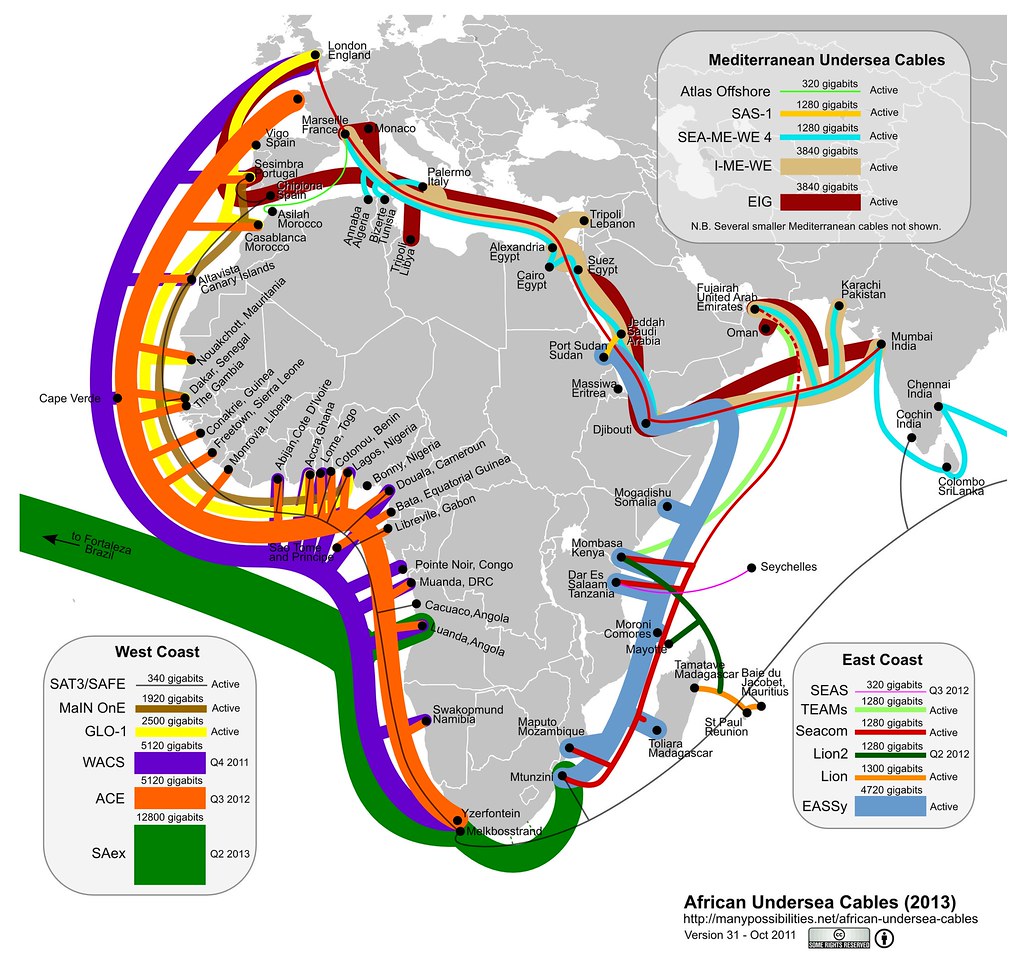
Sub-saharan Undersea Cables in 2013 - maybe (version 31)
Africa Undersea Cables

A revolution is underway in South Africa and for the most part, it us going unnoticed. All major telecoms companies in South Africa i.e. MTN, Vodacom, CellC, Neotel and Telkom have invested heavily in fibre optic cable technology which is currently being laid throughout the country. Digging for the laying of fibre has been taking place in almost every city and town in South Africa as the country gears up for the rise in bandwidth consumption.

The African continent and specifically South Africa will see a number of undersea fibre optic cables landing on its shores, both on the east and west costs of the country. This undersea fibre is aimed at giving South Africa direct internet connectivity to the rest of the world, thus increasing the speeds at which users can access the internet. The undersea cable has therefore made it necessary to lay fibre on land in order to fully leverage the resulting bandwidth throughput. It is predicted that by the end of 2012, all the networks in South Africa would have laid in excess of 15,000 km of fibre across the country.

The SEACOM cable, which is already live and active, can deliver up to 1280 gigabits of data per second and in the longterm, as the underground fibre comes on stream, the benefits of this increased bandwidth will mean faster and faster internet upload and download speeds. Depending on where one lives in South Africa, internet users may already be experiencing improved speeds, whether they are connecting via fixed or mobile platforms. Fibre optic will completely revolutionize how South Africa interacts with the rest of the world via the internet and the benefits will be felt long after the current digging has stopped.


08 November, 2011

Beautiful Joburg


Jacaranda trees with the Joburg Hospital in the background

Just thought i'd share this pitcure showing the Joburg skyline and the beautiful Jacaranda trees. Many people travel the world to see this purple spectacle in Joburg. Enjoy.

07 November, 2011

New Era in road commuting


In the years leading up to the recent 2010 FIFA World Cup, the government of South Africa invested many billions of Rand in infrastructure, including new stadia and new and improved roads and highways. One of the major road infrastructure projects undertaken by the government is the Gauteng Freeway Improvement Project (GFIP) which sought to enhance the road network connecting all parts of Joburg, from north to south and east to west. Building these roads has costs many billions of Rands and by February of this year, SANRAL had raised bonds in excess of R20 billion fund now almost completed GFIP. One of the ways government had envisaged to fund the investment in the road infrastructure is through the introduction of tolls.

For many months, the national Department of Transport through its road management agency, the SA National Road Agency Limited (SANRAL) has been planning a sophisticated open-road tolling system to be piloted on the roads of Joburg. As part of this plan, gantries which will carry the equipment that will be used to read tags mounted on passing vehicles, have been constructed on Joburg's main highway, the N1. While these gantries were being built, a debate on the rates to be charged has been brewing and in August of 2011 Cabinet approved the new toll tarrifs. In the meantime, history was made on 7 November when SANRAL announced that, with immediate effect, motorists can register their vehicles for the new open-road tolling system, to be known as e-toll. 

South Africa has among the highest road traffic in the world and the new open-road tolling system is expected to change the way South Africans commute. You may not agree with the new open-road tolling system, but the roads of Joburg are now simply world class. Government intends to roll out the open-road tolling system throughout the country in the coming years.

05 November, 2011

Digital Migration, SA Hopelessly Behind Schedule


SABC Head Quarters, Auckland Park.


In 2006, the ITU announced that after 2015 it will not support the protection of analogue technology for broadcast purposes which meant that from that point the race for migration towards digital technologies was on. In 2008 the South African government through the Department of Communication (DoC) approved a digital migration policy and the DoC immediately set about putting together its own migration plan. According to that plan, South Africa was set to commence the migration by the end of 2011. The national broadcaster, the SABC still uses the archaic analogue technology for it's television signal transmission and it faces the biggest test among all the other broadcasters in South Africa, as this relates to digital migration.


With less than two months left before the end of 2011, South Africa is nowhere near ready to commence the migration process, thanks to a number of stumbling blocks, least among them the delays by government in reaching a decision on the preferred digital standard. It was only in January of 2011 that the DoC announced that DVB-T2 will be the digital standard that South Africa will adopt. Making this announcement only in January when the migration was due to commence before the end of the year, was a clear sign that South Africa would hopelessly miss its own self-imposed commencement timeline. Now the end of 2013 is the new timeline to commence digital migration. This would leave South Africa with only two years to complete the migration before the 2015 deadlines set by the ITU. South Africa cannot afford to miss the 2015 deadline and the DoC must pull out all stops to ensure compliance.

Our Politicians must demonstrate some will.


03 November, 2011

2012: International Year of Sustainable Energy for All


Wind Energy Farm


The United Nations has declared 2012 as, "International Year of Sustainable Energy for All". The topic of sustainable energy sources is fast gaining momentum and is taking centre stage not only in the developed world but also among third world countries, including South Africa.

Recently, the the government of South Africa signed a memorandum of understanding with the Kingdom of Lesotho regarding energy resources. It is believed that the immediate opportunity between the two countries is the investment in the harnessing of wind generated at the top of the high Lesotho mountain ranges and converting this into electricity, using wind turbines. A few days prior to the signature of the MoU with the Kingdom of Lesotho, South Africa's Minister of Energy, Dipuo Peters was involved with the launch, in the Eastern Province, of a facility that will manufacture flat plate solar panels used in the generation of renewable energy. All of these initiatives take place against the backdrop of COP17 due to take place in Durban from 28 November 2011.

The government of President Zuma must be commended for its efforts and drive towards sustainable development. However, today South Africa, like most other nations around the world continue to rely heavily on crude oil and coal as main sources of energy. Indeed South Africa is among the world's biggest exporters of coal and a major importer of crude oil, both for local consumption and for re-export as refined petroleum products. We must therefore not be fooled into thinking that sustainable energy sources will overtake conventional energy sources any time soon. These conventional energy sources remain too lucrative for any self-respecting capitalist society to abandon them in exchange for solar, wind and the like.

Our Politicians must demonstrate some will.